


Blog
The operating principle of kite movement
As is well known, there are two necessary conditions for kites to ascend to the sky:
(1) Kites can only be flown in windy weather, except for the flying eagle kite.
(2) Kites all need to be pulled with a string, and a "broken kite" will definitely fall off after a short distance.
Boosting effect
The generation of buoyancy: When a kite is exposed to wind in the air, the air will be divided into upper and lower layers. The air in the lower layer of the kite is blocked by the kite surface, causing a decrease in air velocity and an increase in air pressure; The air circulation in the upper layer is smooth, and the flow rate increases, resulting in a decrease in air pressure; The lifting force is generated by the difference in air pressure, which is the reason why kites can rise.
As can be seen from the above, there are two factors that contribute to the generation of lifting force: (1) wind power; (2) Traction force; This explains the question raised at the beginning. Under the action of wind, traction, and the resulting lifting force, kites basically achieve force balance in the air.
The force exerted on a kite in the air: The direction of the wind is generally horizontal, and the angle and magnitude of the upward force exerted on the kite can be easily controlled by lifting the string. After a few practice sessions, kite flyers will quickly master the technique of controlling kites: when flying a kite, it is usually done one by one.
When smoking, because the kite string is usually placed on the top of the kite surface, increasing the traction can control the kite angle to decrease, increase the lifting force, and the kite steadily rises; When flying, the balanced kite's traction decreases. Under the combined force of wind and lift, the kite will fly high and far, but it must be quickly drawn again to maintain the stability of the kite's angle.
When the wind is strong, you can lay more lines, and when the wind slightly decreases, you can retract some lines.
RELATED NEWS
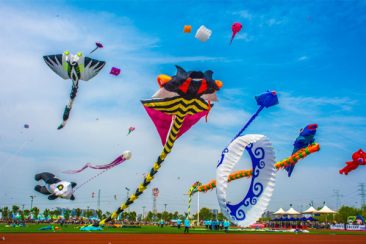
There are various types of sports kites
In addition to the relatively easy to control double line kites, there are also four line, multi line and other sports kites.
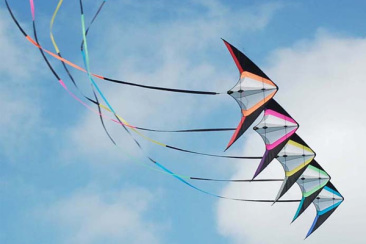
The gameplay of sports kites is also different from traditional kites
It can fly alone, allowing it to freely rotate up and down, left and right, and even pose the kite in windless conditions.

The Development History of Kite Culture
Mozi (Mozi Zhai) passed on the kite making business to his student Lu Ban (also known as the Public Transport Class).
Contact Us
TEL: 86-13964609657
WhatsApp:86-13964609657
ADD:Room 106, Building 5, Weifang Jiashi Incubation Industrial Park, No.5888 Dongwaihuan Road, Hanting District, Weifang City, Shandong Province


Consult Now
Welcome to leave a message, we will contact you in time!